
Research at the LPMMC
Despite the large variety of phenomena and physical systems that we are interested in, our research is based on the use of a common set of theoretical and numerical tools. It aims at the development of fundamental understanding of classical and quantum phenomena in condensed matter physics as well as at applications to new sources of light, interferometry, high-precision measurements, quantum information and quantum technologies.
Research at LPMMC is structured in four main axes:
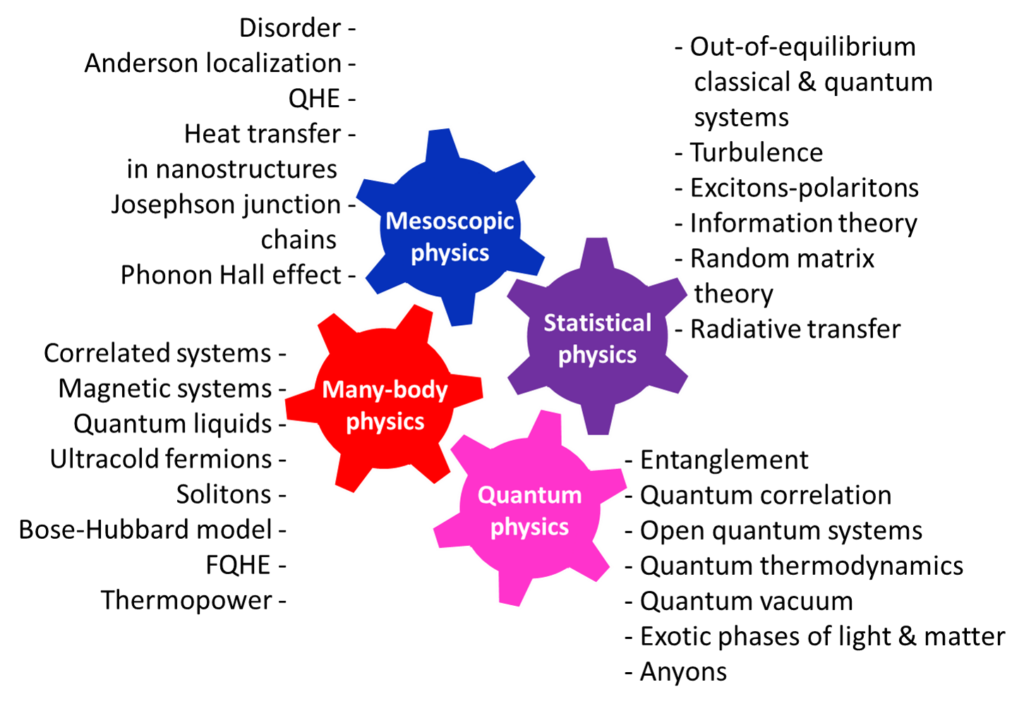
Brief descriptions of each axis are provided below.
Quantum physics
Quantum thermodynamics. This topic is at the intersection of quantum physics and non-equilibrium statistical physics, applied to mesoscopic systems. We study complex quantum systems coupled to simple reservoirs or simple quantum systems coupled to complex reservoirs using a “stochastic thermodynamics” formalism developed for open (markovian and non-markovian) quantum systems. Contact: Robert Whitney
Angular momentum of quantum vacuum. A new and completely unexplored subject is the understanding of the angular momentum of the quantum vacuum, when interacting with a rotating quantum object, possibly exposed to a time-dependent magnetic field. We aim at calculating and observing (in collaboration with colleagues at LNCMI) of classical and quantum Abraham forces arising in this context. Contact: Bart van Tiggelen
Quantum mechanics of anyons. Anyons are quasi-particles half-way between bosons and fermions. Our aim is to derive Hartree/Hartree-Fock-like models of anyons from many-body quantum mechanics, generalizing the mathematical methods available for bosons and fermions. Another research direction is the study of the fractional quantum Hall effect as a manifestation of anyon physics.
Quantum correlations in composite quantum systems. We develop a geometric approach to characterize and quantify entanglement and quantum discord in bipartite systems and apply this approach to study their time evolutions in specific models of condensed matter and quantum-optical systems, as well as in weak measurement processes. In particular, we want to understand geometrically why certain environments produce a fast decay of quantum correlations while others are much less detrimental and therefore more favorable for quantum technological applications.
Examples of recent publications:
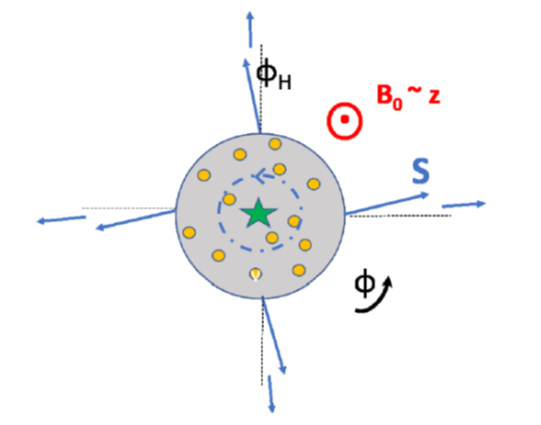
Photon Hall Pinwheel Radiation of Angular Momentum by a Diffusing Magneto-Optical Medium, B. A. van Tiggelen and G. L. J. A. Rikken, Phys. Rev. Lett. 125, 133901 (2020)
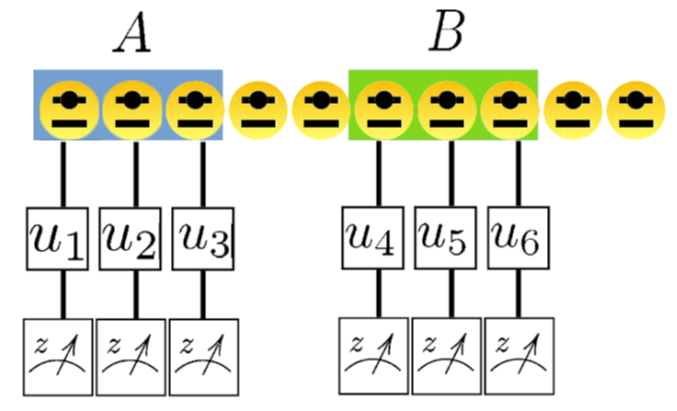
Mixed-State Entanglement from Local Randomized Measurements, A. Elben, R. Kueng, H.-Y. Huang, R. van Bijnen, C. Kokail, M. Dalmonte, P. Calabrese, B. Kraus, J. Preskill, P. Zoller, and B. Vermersch, Phys. Rev. Lett. 125, 200501 (2020)
Statistical physics
Turbulence. We develop a theoretical approach to homogeneous and isotropic turbulence using the non-perturbative renormalisation group formalism. In collaboration with LEGI, we also study turbulence by direct numerical simulations of the Navier-Stokes equation. Contact: Leonie Canet, Vincent Rossetto
Imaging and radiative transfer. We work on the three-dimensional case of the radiative transfer by expanding the solution with respect to the scattering order and apply the results to imaging problems in optics, acoustics, and Earth sciences. We also study the role of longitudinal waves in the radiative transfer of electromagnetic waves. Contact: Vincent Rossetto
Excitons-polaritons. We pursue theoretical studies on exciton-polaritons by exploring new geometries, such as the honeycomb lattice. We also study the strongly interacting one-dimensional case and search for signatures of fermionization (Tonks-Girardeau regime) of polaritons. Contact: Anna Minguzzi
Information-theoretic approach to disordered systems. We work on developing an information-theoretic approach to the understanding of wave scattering in disordered media. The use of such concepts as the entropy and the information capacity is promoted instead of more traditional transport properties (transmittance, conductance, etc.). Contact: Sergey Skipetrov
Euclidean random matrix theory. Random matrices with elements defined via functions of positions in a Euclidean space are used to model the physics of waves in disordered media. We develop analytical approaches to study the statistical properties of eigenvalues and eigenvectors of such matrices and apply them to study wave propagation in disordered environments. Contact: Sergey Skipetrov
Examples of recent publications:
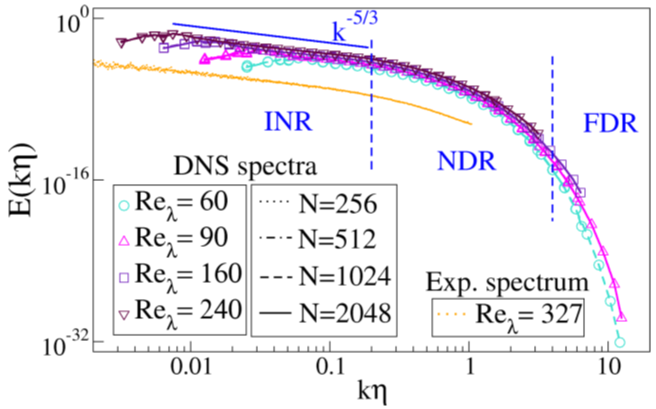
Analysis of the dissipative range of the energy spectrum in grid turbulence and in direct numerical simulations, A. Gorbunova, G. Balarac, M. Bourgoin, L. Canet, N. Mordant, and V. Rossetto, Phys. Rev. Fluids 5, 044604 (2020)
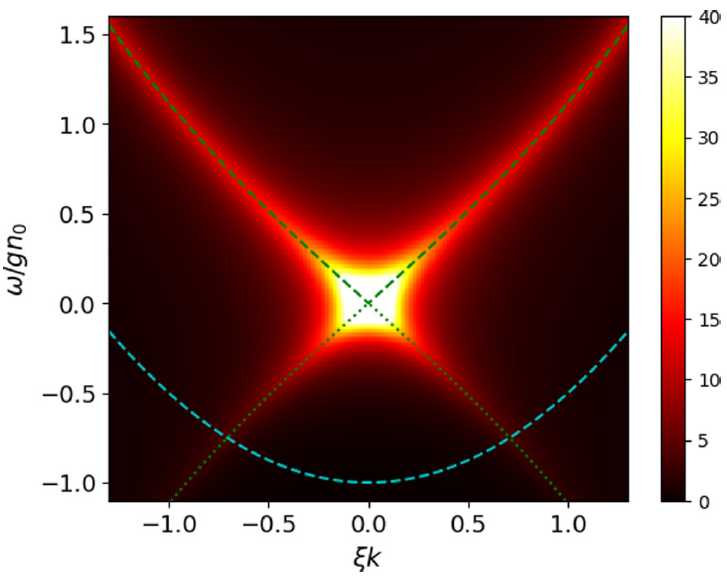
Galilean boosts and superfluidity of resonantly driven polariton fluids in the presence of an incoherent reservoir, I. Amelio, A. Minguzzi, M. Richard, I. Carusotto, Phys. Rev. Research 2, 023158 (2020)
Many-body physics
Quantum liquids. We develop methods for accurate calculation of ground states and spectral properties of quantum liquids, primarily based on Quantum Monte Carlo approach. Applications range from the description of simple metals and semiconductors to high pressure liquid and solid hydrogen. Contact: Markus Holzmann
Ultra-cold fermionic atoms. We study the response of interacting fermions on a ring, both in the case of two-component attractive fermions, to study the BEC-BCS crossover in one dimension, and for the SU(N) case. We also develop new theoretical schemes and innovative numerical tools to address the dynamical properties of SU(N) strongly interacting fermions and calculate the eigenstates of SU(N) quantum magnets. Contact: Anna Minguzzi, Pierre Nataf
Quantum solitons. Bosons with attractive interactions give rise to the quantum analogue of bright solitons. We explore their physical properties and applications to atom interferometry for the development of rotation sensors beyond the standard quantum limit. Contact: Anna Minguzzi
Mathematical derivation of the Bose-Hubbard model. We investigate the mean-field limit for many bosons in a double well potential. We aim at rigorously deriving a Bose-Hubbard two-modes Hamiltonian in a regime of large filling of the wells.
Fractional quantum Hall effect. We develop a field theory of electron pairs for the fractional quantum Hall effect (FQHE). We develop a phenomenological concept of composite fermions and aim at understanding of FQHE as an integral quantum Hall effect for weakly interacting composite particles. Contact: Thierry Champel, Cecile Repellin, Loic Herviou,
Examples of recent publications:
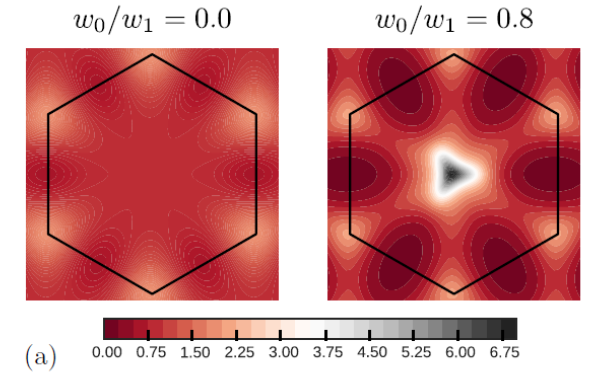
Chern bands of twisted bilayer graphene : Fractional Chern insulators and spin phase transition, C. Repellin and T. Senthil, Phys. Rev. Research 2, 023238 (2020)
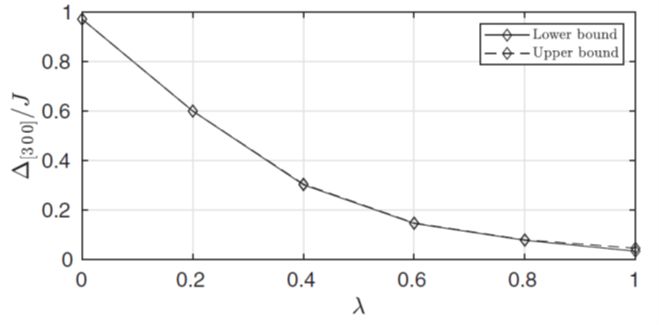
Haldane Gap of the Three-Box Symmetric SU(3) Chain, S. Gozel, P. Nataf, and F. Mila, Phys. Rev. Lett. 125, 057202 (2020)
Physique mésoscopique
Mesoscopic physics
Anderson localization. We explore the role of longitudinal electromagnetic waves and the possibility of reaching Anderson localization of light in 3D disordered media. We also study the interplay between disorder and topology in topologically nontrivial photonic systems with disorder. Contact: Bart van Tiggelen, Sergey Skipetrov
Quantum Hall effect and related phenomena. We develop time-dependent phase space methods for the integer quantum Hall effect (QHE) and explore the exotic phases in light-matter systems in the QHE regime. We also study the conditions of occurrence of the Dicke superradiant phase in cavity quantum Hall electrodynamics. Contact: Thierry Champel, Denis Basko
Contactless heat transfer in nanostructures. Heat tranfer between two electrically isolated metalic objects can proceed by exchange of photons. We study this phenomenon on the nanometric scale and explore its implications for the design of thermal and thermoelectric nano-devices of which the operation can be impaired by the heat leakage. Contact: Denis Basko
Quantum Monte Carlo study of superconductor-insulator transition in Josephson junction chains. The phase diagram of Josephson junction chains is explored in a wide parameter range. The results are applied to interpret experiments on chains with well-controlled parameters (Josephson energy, junction capacitance, island-ground capacitance). Contact: Denis Basko
Examples of recent publications:
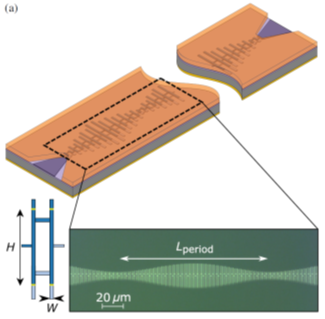
Photonic-Crystal Josephson Traveling-Wave Parametric Amplifier, L. Planat, A. Ranadive, R. Dassonneville, J. Puertas Martínez, S. Léger, C. Naud, O. Buisson, W. Hasch-Guichard, D.M. Basko, and N. Roch Phys. Rev. X 10, 021021 (2020)
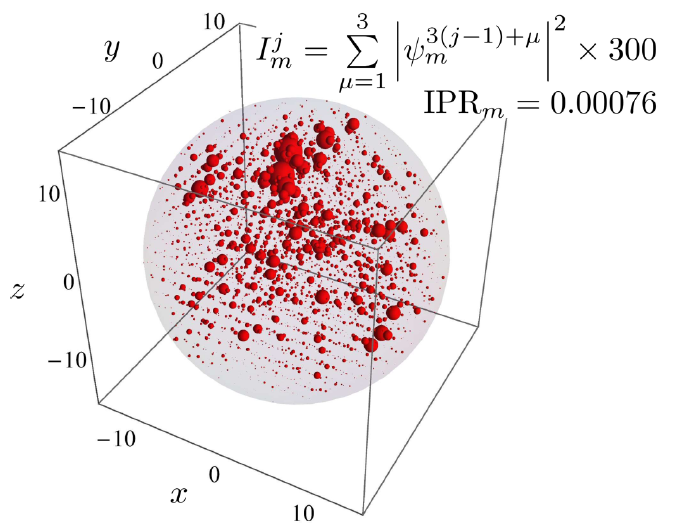
Localization of light in a three-dimensional disordered crystal of atoms, S.E. Skipetrov, Phys. Rev. B 102, 134206 (2020)